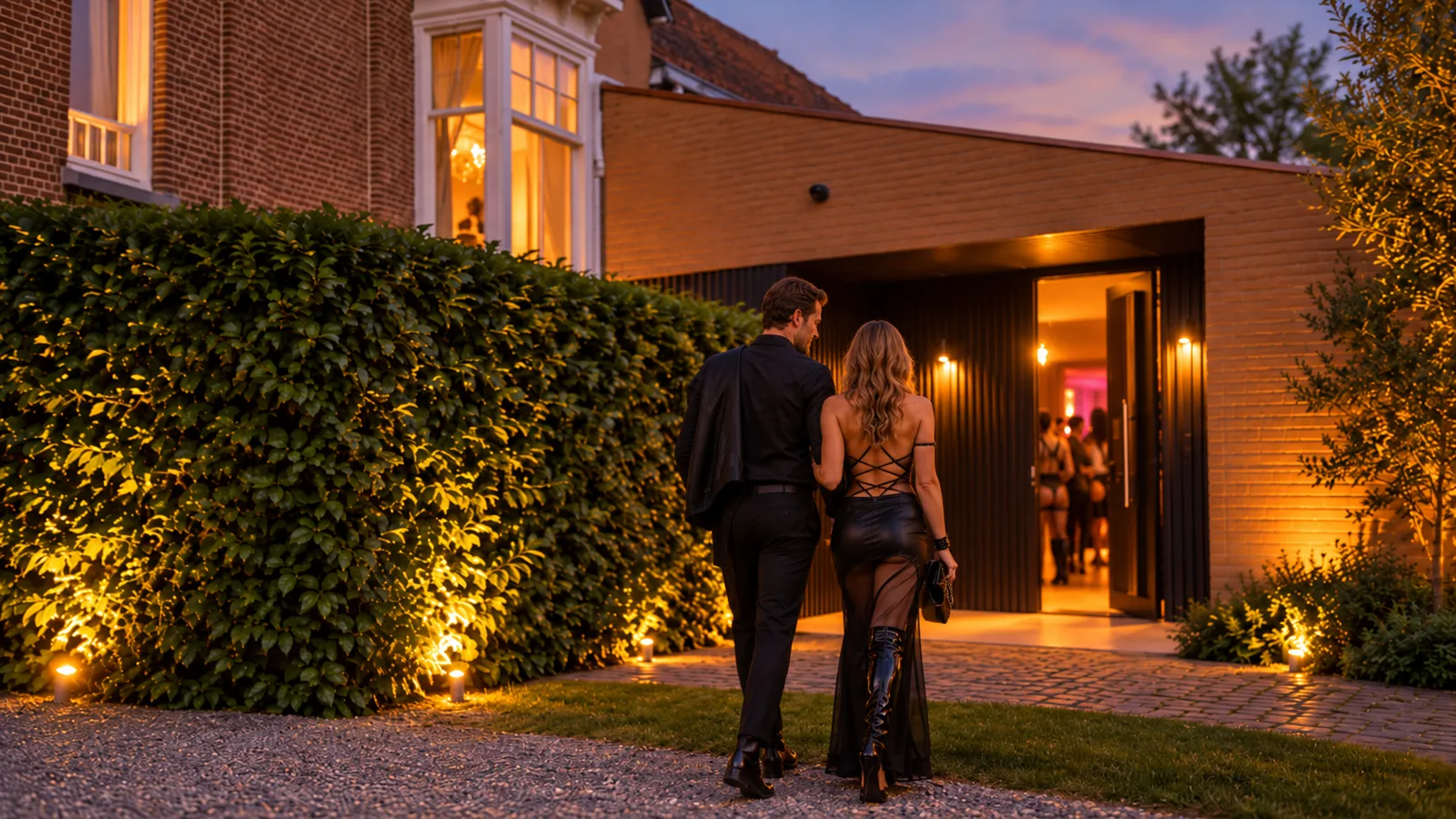
Arrive Before You Open: Why Connection Belongs at the Start of an Intimate Evening
Disclosure: The Conscious Channel is published by Robert Kosse. Together with Veronique of Sacred Healing Arts he hosts The House of Eros in Ghent, which this essay describes. It is written from his own experience as a host.
Why intimate evenings work better when people first arrive in their own bodies, and what changes when connection comes before everything else.
Veronique and I have spent many evenings in sex-positive spaces ourselves. Again and again we saw the same pattern. The doors open, the music starts, the private areas open and many people head straight there. A few regulars know the codes and move through the night with ease. Many others stand at the edge, a little overwhelmed, unsure how to behave, how to make contact or how to say what they want. Some go home feeling emptier than when they arrived.
We do not judge anyone who enjoys those nights. But they are not what we want to create. In our experience the missing piece is rarely more freedom. It is a good beginning.
What people are really looking for
I am convinced that very few people come to these evenings for quick encounters. What most of them are looking for is to be seen and to meet someone for real. Underneath the curiosity there is a wish for connection.
Research on couples points in a similar direction. A 2022 meta-analysis of 93 studies with more than 38,000 people in relationships found that sexual communication goes along with higher relationship and sexual satisfaction. The quality of that communication mattered more than how often people talked about sex (Mallory, 2022). These were people in relationships, not guests at an event. Still, the lesson fits what we see on our evenings: how people speak about their wishes and limits matters more than how much they talk.
Why the evening starts in the body
At The House of Eros nobody drifts in whenever they like. There is a half-hour arrival window, then the doors close. Phones go into a locker. And then we begin together.

Before anything else happens, we invite everyone to close their eyes or soften their gaze. We do a simple breathing exercise. With each exhale people let go of their day and their expectations. With each inhale they land a little more in their own body. All week we are busy with what others think, what others say and how we look. We start the evening by landing in ourselves.
There is a reason for this order. Researchers call the ability to sense what happens inside the body interoceptive awareness. A review of mindfulness-based approaches for women with sexual difficulties found that interoceptive awareness was the factor with the most evidence behind it as a pathway to improvement (Arora and Brotto, 2017). That review looked at a clinical group, not at nightlife. But the principle is simple: you can only notice what you want, and what you do not want, if you can feel yourself.
Slow is not boring
From there we move in small steps. First people stay with themselves. Then they begin to perceive others, just perceive, without judgment: a person with their own needs, their own history and their own pace. Only then do we invite contact, and we keep it slow. The aim is that nobody loses themselves on the way to someone else. You stay in touch with your own body and reach out from there.

This takes a lot of speed out of the room. And it changes the quality of everything that follows. People notice more, of the room and of each other. Approaches such as conscious relating and authentic relating build on the same idea: stay present with your own experience while you meet someone else.
Consent you can feel, not just recite
Our rule is short: a maybe is a no. Only a clear, enthusiastic yes is a yes. A rule alone does not help much if people cannot sense their own yes or no in the moment. So we practise it. In the opening and in the guided part, guests say no in a group and to people they have just met. When the moment matters later in the night, it is no longer the first time.
Research on couples points the same way. In three studies with adults in romantic relationships in China, people who felt a clear inner willingness, or who expressed consent in clear words, reported higher sexual and relationship satisfaction, and their partners often did too. Passive consent, simply going along, was linked to lower sexual satisfaction for both partners and to more distress for the person who went along (Shi, Impett and Zheng, 2025). In these couples, felt and spoken consent went along with more satisfaction, not less.
During the night an Angel Team is present and visible. They support consent culture, offer grounding and step in when something feels unclear.
Learning with guidance instead of trial and error
At many evenings guests get space but little guidance. Newcomers are left to find their own way. Some try things they have never learned and it goes wrong. Others freeze because they have no idea what to do.
We chose the opposite. After the opening, guests pick one of three Spheres, each led by experienced bodyworkers, facilitators and teachers. One leans tantric, one explores power and play, one is for couples or works through movement. People can learn something new or try a new direction in a protected setting. The facilitators guide, answer questions and look after the group. There is a lot to learn and a lot to laugh about, but what matters most is connection. Then a short collective breath leads into the free part of the night.

What changes after the guided part
The difference is visible. After the workshops people act with much more awareness. They take time for themselves, and couples take time to tune in to each other first. They talk more openly about their needs, their wishes and also their limits. Saying no comes more easily, because they have already practised it with strangers earlier that evening. Connections feel warmer, and in our experience people simply leave happier.
Two voices from guest reviews after past editions:
“No pressure to perform, no expectations to fulfil. Just space to discover what feels right for you and others.”
Kevin, Edition III“I have never felt so connected in such a large group before.”
Sam, Edition I
A small practice you can take home
You do not need a special evening to try the core of this. Before any intimate encounter, alone or with a partner:
- Land. Close your eyes or soften your gaze and take three slow breaths. Notice where you feel your body most clearly right now.
- Ask yourself. What would I like tonight? What do I not want tonight? Notice what your body answers before your head jumps in.
- Say one of each. Share one wish and one limit out loud. Listen to the other person’s answer without trying to change it.
It takes two minutes. It can set the tone for the whole evening.
Why we do this

We believe people learn connection and consent best through real experience, with guidance and in a safe setting. That is how you learn to read a room, to understand and feel a situation and to move through it with confidence. And that is what allows you to make good decisions for yourself.
At our evenings, sex is never the goal. If it happens, it grows out of real moments people created together. An evening that combines guided workshops with a free, open night is still rare in Belgium. We would love to see more of it.

About The House of Eros
A somatic intimacy club in a private villa in Ghent, produced by VeRo Entertainment and Sacred Healing Arts and hosted by Veronique and me. The first half of the night is guided, the second half is free. For adults 18+, singles and couples. The next edition is on Saturday 5 December 2026, with further dates until June 2027.
Coming for the first time? Read the first-time guide. Curious about the workshops? See the Spheres and workshops and all past editions. For a smaller circle there is our sister evening Maison Intime. More information: houseoferos.be.
As noted above, the publisher of The Conscious Channel co-hosts The House of Eros. This essay shares personal experience and published research for educational purposes. It is not medical, psychological or legal advice.
Sources
- Mallory A.B. (2022). Dimensions of couples’ sexual communication, relationship satisfaction, and sexual satisfaction: A meta-analysis. Journal of Family Psychology, 36(3), 358-371. Link
- Arora N., Brotto L.A. (2017). How does paying attention improve sexual functioning in women? A review of mechanisms. Sexual Medicine Reviews, 5(3), 266-274. Link
- Shi X., Impett E.A., Zheng Y. (2025). The impact of sexual consent on sexual and relationship well-being in Chinese romantic relationships. Journal of Sex Research, 62(8), 1514-1531. Link
This article was researched and drafted with the help of AI tools and is based on the sources cited in the text. It is general information, not medical, psychological or legal advice. Images are illustrations (AI-generated or licensed stock) unless credited otherwise. Our editorial standards