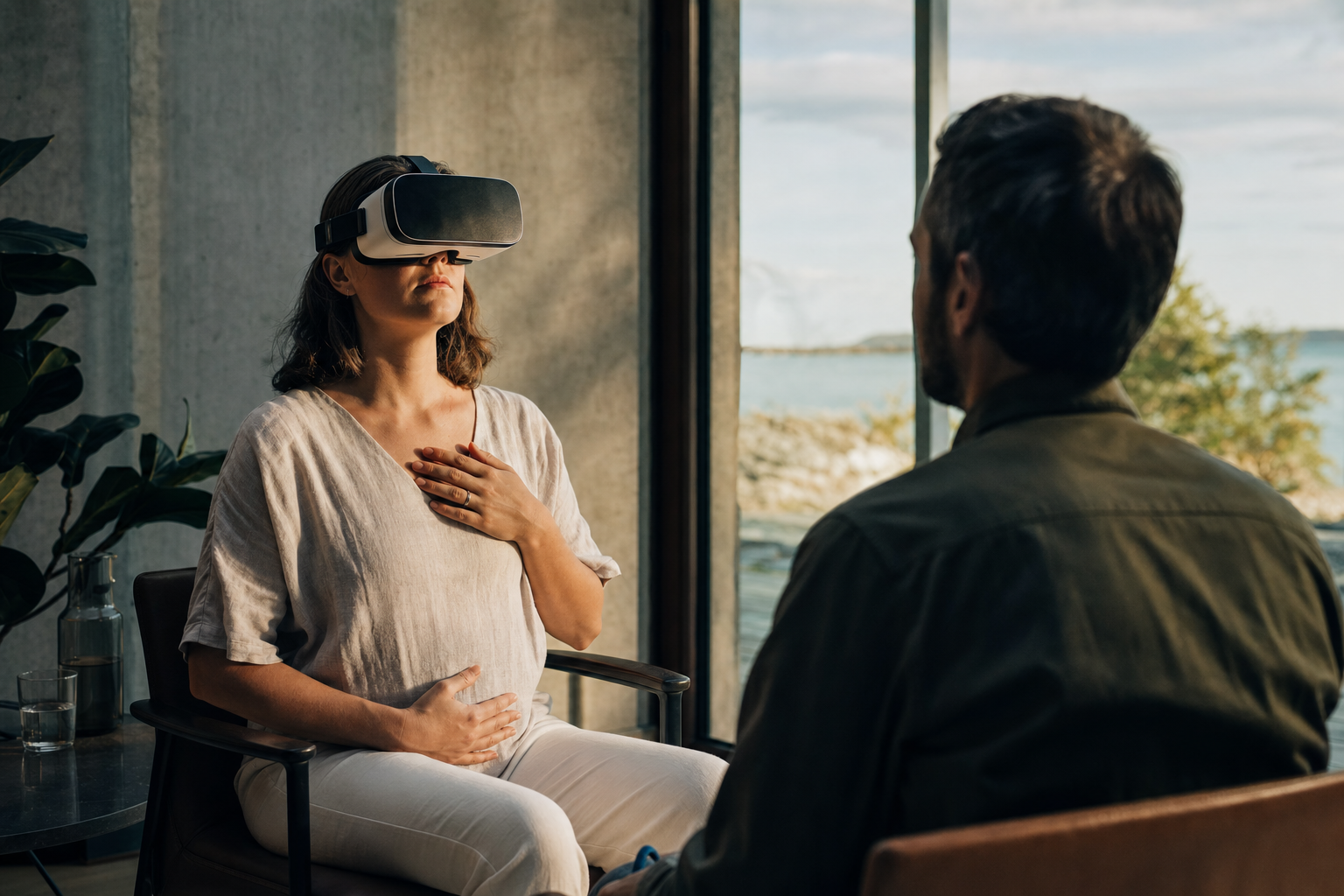
VR training is emerging as a practical tool for exposure-therapy adoption and somatic work
1. What is happening?
A report shared by Medical Xpress highlights research into whether virtual reality can help therapists build confidence and skill in delivering exposure therapy, a clinical method that asks clients to gradually approach feared cues in a controlled way. The study points to a practical direction for VR Somatic Therapy: not only as a client-facing tool, but as a training environment where practitioners can rehearse complex therapeutic moments before applying them in live care. The core news is not that VR replaces therapists, but that it may support wider and more consistent adoption of exposure-based methods.
2. The Somatic & Systemic Context
Exposure therapy depends on careful pacing, consent and nervous system literacy. In clinical terms, the client is supported to meet a feared stimulus without avoiding it, while the body learns that the cue is not always linked to danger. For somatic practitioners, this process is recognizable: orientation, breath, posture, muscle tone, impulse tracking and the felt sense all matter because threat learning does not live only in thoughts. It is expressed through bracing, shutdown, vigilance, freezing, rapid heart rate and protective movement patterns.
The Medical Xpress coverage of the VR training research situates virtual reality as a bridge between theory and applied skill. That matters systemically because exposure therapy is often underused, even when it is clinically relevant. Many practitioners report hesitation around pacing, client distress, session structure or the risk of moving too fast. VR can create repeatable training scenarios where the practitioner rehearses timing, language and regulation support without placing a real client in the middle of a learning curve.
The academic reference connected to this topic also places VR within a growing psychotherapy and psychological research landscape. The value is not simply technological novelty. It is the capacity to simulate context, evoke embodied responses and allow structured repetition. For trauma-informed somatic work, this raises an important question: how can digital embodiment tools be used without bypassing relational safety, scope of practice and the body’s own pacing?
3. The Dual Perspective
What this means for daily life
If you are a client or someone interested in nervous system regulation, the relevant takeaway is simple: the body often needs graded, manageable practice to update threat responses. Avoidance can bring short-term relief, but it may also keep the nervous system organized around danger. Gradual exposure, when done with appropriate clinical support, can help the body learn that a sensation, image, place, memory cue or social situation can be approached without immediate overwhelm.
VR may eventually make some forms of practice more accessible. A person with fear of flying, public speaking, heights or certain social environments might be able to engage with realistic cues in a contained setting before entering the real-world situation. The body still responds – shoulders lift, breath changes, the jaw tightens, the eyes scan. That response is the material of the work.
For daily life, this does not mean forcing yourself into situations that exceed your capacity. A somatic lens asks different questions: Can I notice the first signs of activation? Can I stay connected to the room I am in? Can I feel my feet, track my breath and pause before I override myself? Can I distinguish between discomfort that is workable and overwhelm that signals the need to slow down?
VR tools may support this learning, but they do not remove the need for discernment. If symptoms include intense panic, dissociation, traumatic re-experiencing, compulsive avoidance or severe functional impairment, exposure-based work belongs with a licensed mental health professional trained in that area.
What this means for your practice as a coach, facilitator or bodyworker
For practitioners, the practical significance is training infrastructure. Exposure therapy is not simply “helping someone face a fear.” It is a clinical intervention with assessment, case formulation, contraindication screening, pacing, consent procedures, documentation and risk management. VR may help licensed therapists rehearse these competencies in a simulated environment. For coaches, facilitators and bodyworkers, the boundary is clear: do not present exposure therapy as a service unless it falls within your license, training and legal scope.
That does not make the news irrelevant to non-clinical somatic practitioners. It clarifies where your work can support the wider ecosystem. You may help clients build interoceptive awareness, grounding capacity, orienting skills, boundary language and post-session integration. You may also help them notice when their system is moving into fight, flight, freeze or collapse. These are valuable supports, but they are not a substitute for clinical exposure therapy when a diagnosable condition is being treated.
For licensed clinicians, VR training may reduce barriers to applying exposure-based care with more structure. A simulated scenario can help practitioners practice how to introduce exposure, respond to distress, maintain therapeutic alliance and avoid over-reassurance. It can also standardize training across teams, which is relevant for clinics, supervision groups and continuing education providers.
For somatic businesses, the opportunity is ethical collaboration. A trauma-informed bodyworker might partner with licensed therapists who use VR-based exposure, offering complementary regulation work outside the exposure session. A coach might support values-based planning, daily routines and reflective tracking while the clinical work remains with the treating therapist. The business advantage is not claiming a clinical niche without authority. It is becoming precise, referable and trustworthy.
4. Key Takeaways
- VR training may help therapists rehearse exposure-therapy skills before live client work.
- Somatic practitioners can support regulation and integration, but clinical exposure work requires appropriate licensure.
- Digital embodiment tools are most useful when they preserve pacing, consent and relational safety.
Sources & References:
- Original News – „Virtual reality helps therapists with exposure therapy“
- Context – „Medical Xpress report on VR and exposure-therapy training“
- Reference – „Journal article on virtual reality in psychotherapy research“
Recommended Video Resource:
Why we recommend this: This video offers a practical look at body-tracking hardware that helps explain how movement can become part of digital embodiment.
Further Reading on The Conscious Channel:
For more coverage on ethical digital tools in trauma-informed care, explore our Tech & Digital Embodiment section and look for upcoming analysis on VR-assisted clinical training, body tracking and somatic integration.
#VRTherapistTraining #ExposureTherapySkills #TechDigitalEmbodiment #VRSomaticTherapy