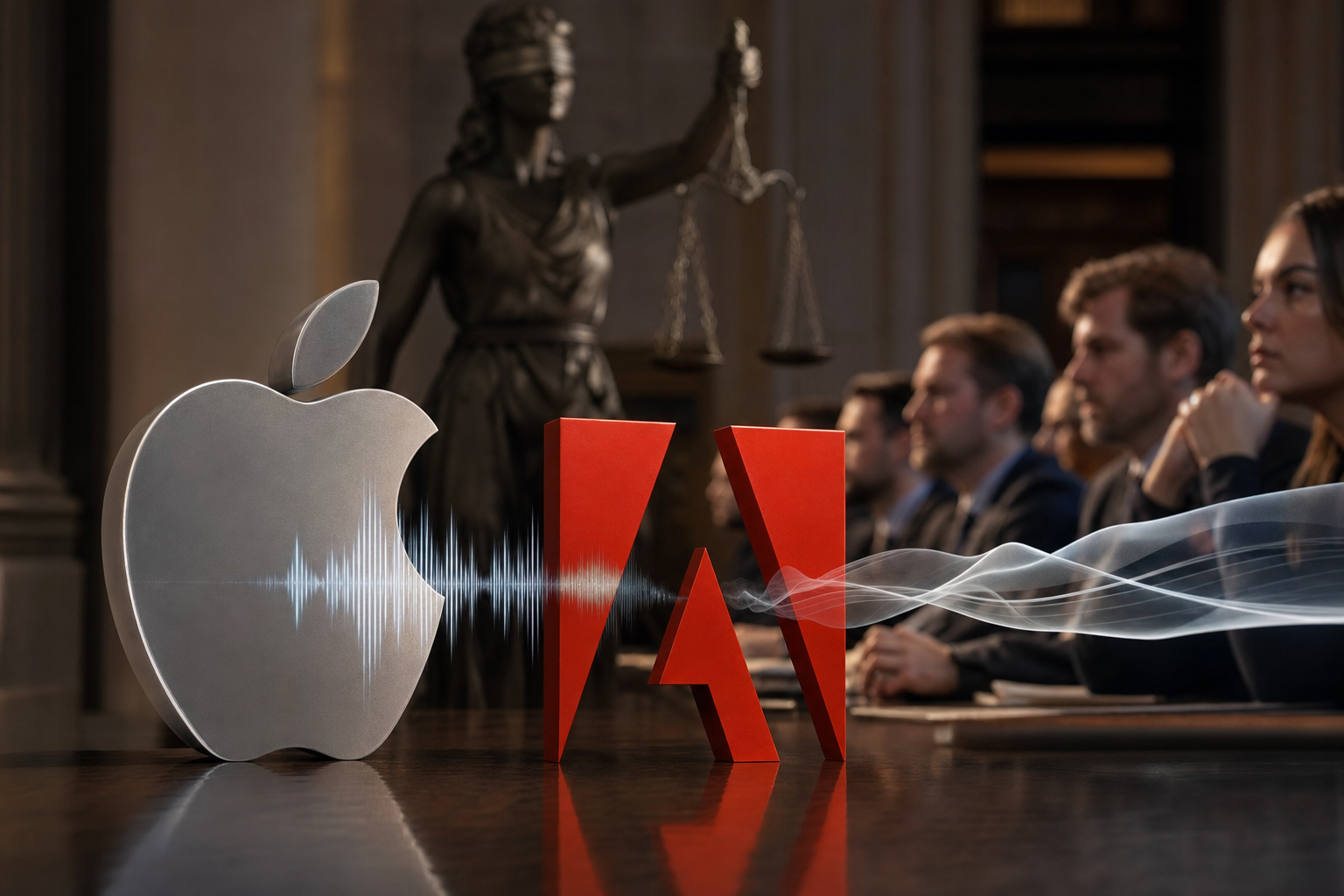
Apple and Adobe Face Biometric Privacy Class Action Over Alleged Misuse of Voice Data for AI Training
1. What is happening?
A new Illinois class action accuses Apple and Adobe of violating the state’s Biometric Information Privacy Act by allegedly using voice recordings from journalists, voice actors and other professionals to train generative AI systems without informed consent. The case centers on whether voice data can function as biometric information and whether companies must provide clear notice, opt-in consent and retention policies before using audio in AI development. For teams working in Tech & Digital Embodiment and data privacy, the lawsuit signals rising legal risk around biometric privacy class action claims tied to AI training datasets.
2. The Somatic & Systemic Context
Voice is not only communication. It carries identity, emotional tone, stress signals, physiological patterns and relational cues. That is why the alleged use of recorded voices for AI training raises concerns beyond copyright or platform policy: it touches the body’s trace in digital systems.
The broader pattern is visible in workplace technology as well. Reporting summarized by „CBS News Data Privacy“ describes concerns around Meta’s reported plan to monitor employee computer activity to generate data for internal AI training. In both cases, the issue is not only that data is collected. The deeper concern is whether people understand what is being captured, how it will be modeled and whether they can meaningfully refuse.
A PubMed-listed reference, „PubMed Reference PMID: 34982037“, points to a growing scientific context in which digital signals can be used to infer personal or health-related patterns. For somatic practitioners, this matters because the body is increasingly translated into data: voice, movement, facial expression, typing behavior and interaction patterns can become machine-readable proxies for states that were once private, relational or clinically sensitive.
3. The Dual Perspective
What this means for daily life
For clients and consumers, this case is a reminder that a voice recording is not neutral. A podcast interview, app interaction, work call or creative file may contain more than spoken words. It can include tone, breath rhythm, fatigue, hesitation, activation and emotional load.
That can affect the nervous system. When people feel observed without clear agreement, the body may respond with vigilance: checking behavior, reduced spontaneity, tension in the jaw or throat, shallow breathing or reluctance to speak freely. These reactions are not irrational. They are boundary responses to unclear data use.
Practical steps are simple but significant: review consent settings before uploading audio, ask how recordings will be stored and used, avoid sharing sensitive voice material on unclear platforms and notice how your body responds when digital tools feel intrusive. If your throat tightens or your attention narrows around being recorded, treat that as useful information about consent and safety.
What this means for your practice as a coach, facilitator or bodyworker
For practitioners, the legal signal is clear: audio can carry sensitive biometric and identity-related information. If you record sessions, voice notes, intake interviews, testimonials, group calls or training material, you need explicit permission and clear policies.
This applies even if the recording is not clinical. Consent should specify what is recorded, why it is recorded, where it is stored, who can access it, how long it is retained and whether it will ever be used for transcription, AI tools, marketing, supervision or training. A general “we may record” notice is unlikely to meet the ethical standard clients expect in trauma-informed work.
Practitioners using AI transcription or note-taking tools should review vendor terms carefully. If a third-party service uses uploaded audio to improve its models, that may create risk for the practitioner and a breach of trust with clients. Session recordings should not be treated as casual productivity assets. They are relational records containing voice, affect and potentially vulnerable disclosures.
For somatic and trauma-adjacent work, the standard should be higher than minimum compliance: informed opt-in, easy withdrawal, data minimization and non-recording as the default when possible.
4. Key Takeaways
- Voice data can carry biometric and emotional information.
- AI training without explicit consent creates legal and relational risk.
- Practitioners need clear recording, retention and vendor policies.
Sources & References:
- Original News – Law360 Cybersecurity & Privacy – „Law360 Cybersecurity & Privacy“
- Context – CBS News Data Privacy – „CBS News Data Privacy“
- Reference – PubMed Reference PMID: 34982037 – „PubMed Reference PMID: 34982037“
Recommended Video Resource:
- Workplace Surveillance + AI = Silent Firing – „Workplace Surveillance + AI = Silent Firing“
Why we recommend this: This video helps connect AI monitoring with the embodied stress of being constantly observed.
Further Reading on The Conscious Channel:
For more on how digital systems interact with consent, embodiment and professional ethics, explore our coverage on „Tech & Digital Embodiment“ and „Data Privacy“.
#BiometricVoiceData #AITrainingConsent #TechDigitalEmbodiment #DataPrivacy