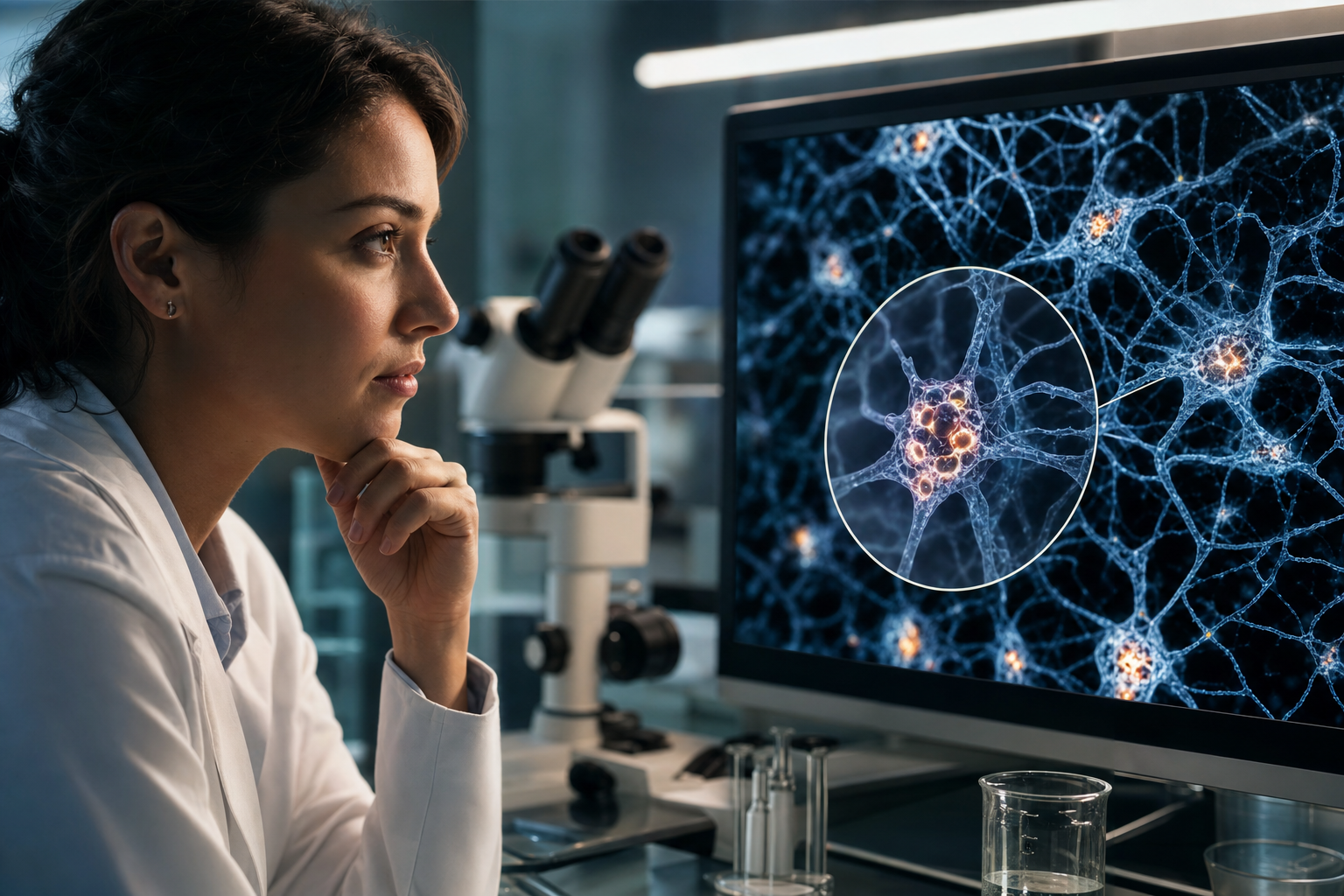
Tiny Neuron Cluster Found to Act as Built‑In “Focus Filter” in the Brain
1. What is happening?
Neuroscientists have identified a small population of neurons in an evolutionarily ancient brain region that appears to selectively filter incoming information, helping the brain reduce distraction and maintain task-relevant focus. According to the reported findings, this cluster functions like an internal attention gate by suppressing irrelevant signals before they dominate behavior.
2. The Somatic & Systemic Context
Attention is not only a cognitive skill. It is also a nervous system process shaped by arousal, sensory load and body-based regulation. Context from Max Planck research on the brain’s “blue spot” – the locus coeruleus – shows that deep-brain and brainstem systems can influence how strongly the brain responds to relevant or irrelevant stimuli. This region is linked to noradrenaline signaling, alertness and flexible attention, which helps explain why focus can change with stress level, fatigue, breath rhythm, posture and internal body awareness.
The reference work in Cell adds depth to this picture by pointing toward precise neural mechanisms involved in selective attention. For somatic practitioners, the relevance is practical but not simplistic: body-based approaches do not “control” a single brain switch. They may support the conditions under which attentional networks can stabilize – lower sensory overwhelm, clearer interoception and better capacity to stay oriented to a chosen task or relational cue.
3. The Dual Perspective
What this means for daily life
If you struggle with distraction, sensory overload or difficulty staying present, this research offers a more precise frame: focus is not just willpower. The brain constantly filters sound, movement, visual input, body sensations and emotional cues. When the nervous system is highly activated or depleted, that filter may become less efficient.
This can show up as feeling flooded in busy spaces, losing track during conversations, becoming easily pulled into notifications or needing excessive effort to complete simple tasks. Gentle regulation practices may help by reducing competing input: slower exhalation, orienting to one stable visual point, feeling the feet on the ground or pausing before switching tasks. The aim is not to force attention. It is to reduce load so the brain has fewer signals to sort through.
What this means for your practice as a coach, facilitator or bodyworker
For practitioners, the findings support a key clinical and ethical point: attention is embodied. A client’s difficulty focusing may reflect nervous system state, sensory burden, sleep debt, environmental demand or unresolved relational stress. It should not be framed as laziness or lack of discipline.
In sessions, this points toward structured sensory simplicity. Reduce competing stimuli, pace instructions, allow pauses and track whether the client’s attention stabilizes or fragments. Breath work, interoceptive inquiry and posture-based practices can be used as supportive tools for attentional regulation, while staying within scope of practice. Avoid diagnostic claims, avoid promising neurological change and refer out when attention problems are severe, sudden, worsening or linked with medical, psychiatric or neurological concerns.
4. Key Takeaways
- Focus depends on filtering, not just effort.
- Deep-brain systems help decide what gets attention and what gets suppressed.
- Somatic work may support attention by lowering sensory load and stabilizing arousal.
Sources & References:
- Original News – „ScienceDaily Neuroscience News“
- Context – „How the brain’s blue spot helps us focus our attention“
- Reference – „Cell reference article on attention and neural filtering“
Recommended Video Resource:
Why we recommend this: It gives a clear evolutionary frame for understanding why attention systems are built into older brain structures.
Further Reading on The Conscious Channel:
No internal further-reading link was provided with the source package.
#FocusFilter #LocusCoeruleus #ScienceAndHumanBehavior #NeurobiologyAndBrainResearch