Evolution of Brain Circuits for Light–Dark Processing Illuminated by Blind Cavefish
1. What is happening?
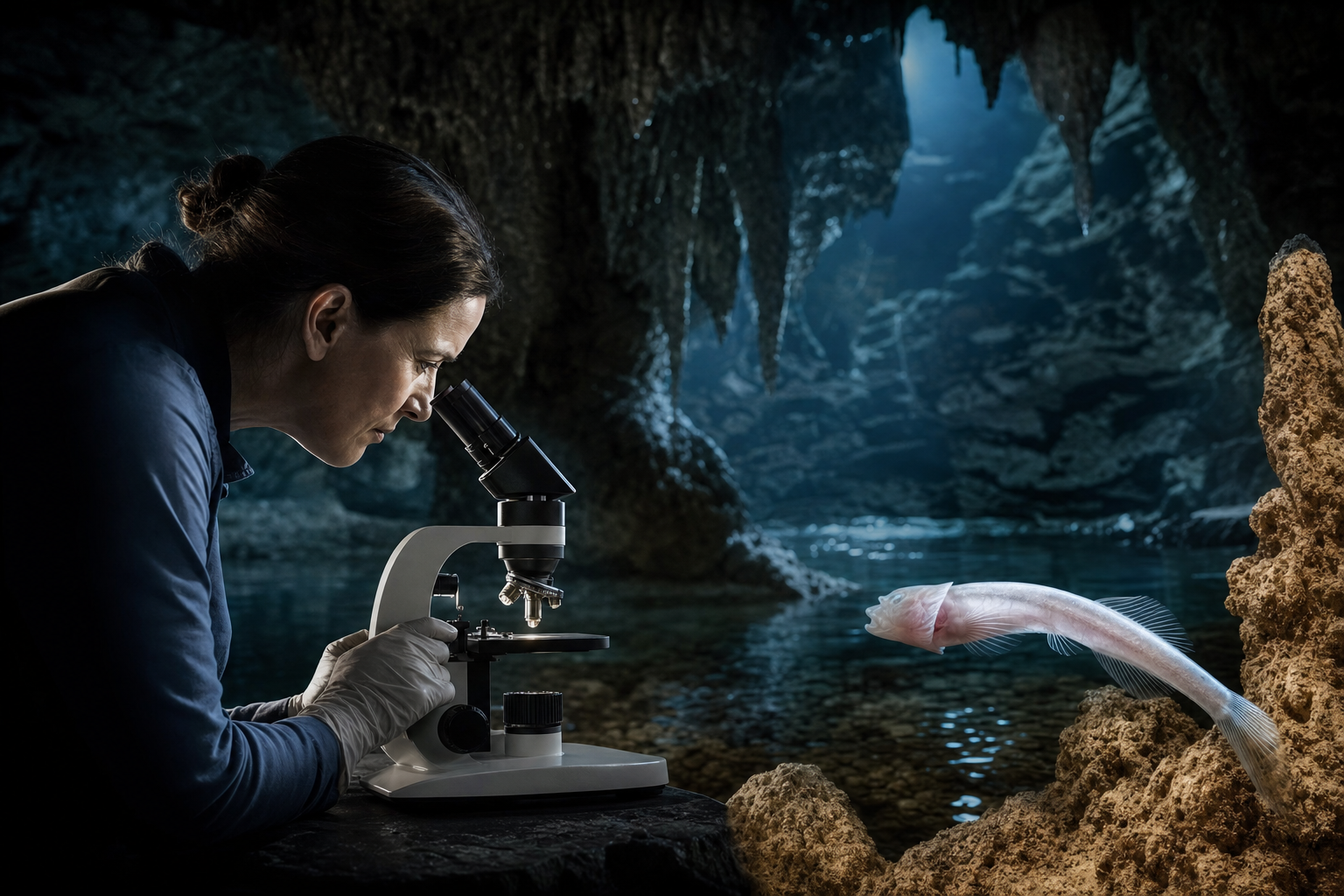
Researchers at Florida Atlantic University report that blind Mexican cavefish have evolved brain circuits that reverse typical light-dark processing responses, despite lacking functional vision. The work suggests that vertebrate sensory networks can be radically reorganized when visual input is lost over evolutionary time, offering a clear model for studying neural plasticity in real environmental conditions.
2. The Somatic & Systemic Context
The findings connect directly to a core principle in neurobiology: the brain does not simply receive sensory information – it continuously adapts to the type, intensity and reliability of that input. In the cavefish model described by Erik Duboué, cave-dwelling fish have developed altered neural responses after generations in darkness, showing how sensory loss can reshape brain function rather than merely reduce it: „Cavefish Evolution: Neural Adaptation“.
For somatic practitioners, the broader relevance is not that human nervous systems operate like cavefish brains. The relevance is that long-term sensory conditions matter. Chronic pain, limited movement, touch deprivation, persistent threat perception or reduced access to orienting cues may contribute to durable changes in how the nervous system prioritizes signals. The Science Advances reference deepens this by placing the work within circuit-level neuroscience, where conserved vertebrate pathways can be repurposed under strong environmental pressure: „Science Advances Reference on Cavefish Brain Circuit Evolution“.
This supports a careful, non-reductive view of regulation. Nervous systems are shaped by context, repetition and adaptation. What looks like over-responsiveness, shutdown, sensory seeking or avoidance may reflect a system that has learned to survive inside a particular sensory world.
3. The Dual Perspective
What this means for daily life
If your body responds strongly to light, sound, touch, movement or interpersonal tension, this research offers a useful frame: sensory responses are not only about willpower or preference. They are shaped by nervous system learning.
In daily life, that may show up as fatigue after crowded environments, discomfort with certain kinds of touch, difficulty settling after stimulation or a strong pull toward predictable routines. The practical implication is to work with input gradually. Instead of forcing exposure or trying to override discomfort, it may help to notice which cues support orientation: softer light, slower transitions, reliable boundaries, grounding pressure, movement breaks or reduced sensory load.
The cavefish research does not provide a direct protocol for human regulation. It does, however, reinforce that sensory environments are biologically meaningful. Small, consistent changes in light, sound, space and movement can become part of how the nervous system updates its sense of safety and capacity.
What this means for your practice as a coach, facilitator or bodyworker
For practitioners, this research strengthens the case for sensory literacy in sessions. Client responses to touch, pacing, light level, movement range, eye contact or silence should be treated as clinically relevant information within scope, not as resistance or lack of commitment.
In practical terms, this means asking clearer intake questions about sensory sensitivities, pain history, movement restrictions, sleep patterns and environmental stressors. It also means designing sessions with adjustable inputs: lighting, distance, contact pressure, verbal pacing, choice points and opportunities to pause. The ethical focus remains consent, titration and client agency.
Scope of practice is key. The cavefish findings are neuroscience evidence about adaptive brain circuitry, not permission to diagnose neurological conditions or make medical claims. Coaches and bodyworkers can use the research to explain general principles of adaptation, support interoceptive and sensory awareness and refer out when symptoms suggest medical, psychiatric or neurological evaluation.
For business and professional standards, the takeaway is clear: trauma-informed and somatic work benefits from being specific. “Nervous system regulation” should not remain a vague promise. It should translate into observable session design: pacing, sensory tracking, explicit consent, clear boundaries and client-led adjustment.
4. Key Takeaways
- Sensory circuits can reorganize deeply when the environment changes over time.
- Light-dark processing in blind cavefish shows adaptation, not simple loss of function.
- Somatic practice can apply this insight through careful pacing, consent and sensory-aware session design.
Sources & References:
- Original News – „Florida Atlantic University Brain Institute“
- Context – „Cavefish Evolution: Neural Adaptation“
- Reference – „Science Advances Reference on Cavefish Brain Circuit Evolution“
Recommended Video Resource:
Why we recommend this: The visual format helps readers understand how brain structure and sensory adaptation can be studied in three dimensions.
Further Reading on The Conscious Channel:
For more reporting at the intersection of body-based practice and brain research, follow our continuing coverage in Science & Human Behavior and Neurobiology & Brain Research.
#CavefishNeuroplasticity #LightDarkProcessing #ScienceAndHumanBehavior #NeurobiologyAndBrainResearch